
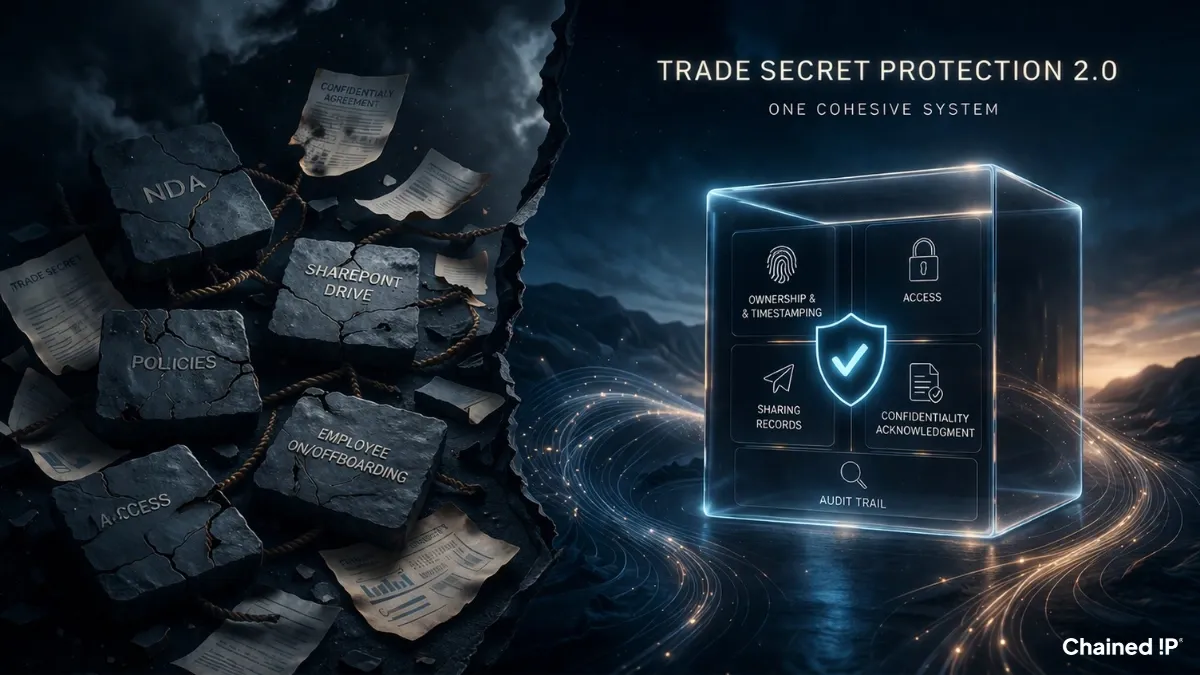
Trade secret protection simplified from fragmented measures to one cohesive system.
Trade Secret Protection in 2026: Simplified with One System
Most companies believe that their trade secrets are protected until they must prove it.
It Is Time to Upgrade to Trade Secret Protection 2.0
Trade secrets represent one of the most valuable assets for companies across industries, holding commercial value and providing competitive advantage. For many years, companies relied on NDAs, confidentiality clauses, and internal policies as the foundation of trade secret protection. But 2016 became a decisive and costly turning point where the EU Trade Secrets Directive and the US Defend Trade Secrets Act harmonized that,
without provable “reasonable protection measures”, a trade secret is not a trade secret.
Ten years have passed and trade secret disputes continue to result in the loss of critical know-how coupled with massive financial losses as companies fail to implement effective and scalable preventive strategies. Today, “trade secret protection 2.0” is no longer just about trust, but it is about evidence, structure, and the ability to show that a protection system was in place.
Accountability Is Missing in Trade Secret Management
Although firms value trade secrets highly, the Deloitte IP 360 survey (2023) reveals that only 23% actively create trade secrets with reasonable measures, while a combined 43% either lack formalized processes or fail to capture trade secrets altogether, exposing significant vulnerabilities in protection and enforcement. This is largely due to a lack of awareness and the absence of a standardized methodology that IP owners can readily implement. As reflected in the Deloitte findings, responsibilities are often delegated to business units by IP teams without compliance mechanisms or accountability structures, leading to fragmented and ineffective trade secret management. This gap reflects a failure at the very first stage of trade secret asset management, identification, which should logically precede classification, protection and valuation of the trade secret. That is not a complex task when approached strategically within an IP strategy that balances patents with trade secrets.
Avoidable Damages: The Cost of Weak Protection
In the US, over 85% of trade secret theft cases involve insiders, employees, former collaborators, or business partners. For example, Hytera hired ex-Motorola engineers who stole trade secrets, resulting in $407.4M damages. Some other recent examples related to avoidable damage would be the Zunum vs. Boeing case, where a $72 million verdict was overturned because Zunum failed to provide sufficient proof that its proprietary information qualified as protected trade secrets. Similarly, in the high-profile Appian vs. Pegasystems lawsuit, a $2 billion verdict was voided due to insufficient safeguards and lack of demonstrable protection measures.
In 2025, in the US alone, trade secret filings exceeded 1,500 cases, marking the highest level ever recorded (+15% increase against 2024), according to the LexisNexis Lex Machina report. From 2023 to 2025, cases that proceeded to trial lasted a median of 3 years, while juries awarded more than $716 million in actual damages and $510 million in punitive damages. These cases clearly demonstrate that trade secret protection is no longer a theoretical concern, but a high legal and financial priority.
In a striking 2025 case, a fashion design company was ahead of the game and avoided major losses when a French court accepted their blockchain timestamps as proof of copyright ownership for their designs. The counterfeiter was ordered to pay €11,900 damages plus legal fees showing that blockchain serves as a "reasonable protection measure" that secures swift court wins!
The Need for One Cohesive System
In today’s extensive information exchange, cloud storage, remote work, fast innovation, global collaboration, and digital licensing, is signing an NDA and telling people to "keep it secret" sufficient? Does labeling documents as “trade secret” on SharePoint or Google Drive, combined with need-to-know access, hold up in court? Are employee IP onboarding and offboarding procedures enough?
While trade secrets must often be shared with employees, licensees, collaborators, or investors, these measures can become operationally overwhelming, leading teams to seek shortcuts or ignore them altogether. The gap is clear: what organizations lack is not more rules, but a simple, integrated, and enforceable all-in-one system.
The standard has shifted to demanding proof. Courts now look beyond signed legal documents to see if organizations have implemented traceable and consistently enforced measures managing trade secrets in practice. The greater the security measures, the more likely that it is a protectable trade secret. IP owners must demonstrate:
- Ownership and existence of the secret at a certain date including documented iterations and improvements
- Controlled, documented access to sensitive information for each trade secret
- Clear identification and classification of trade secrets
- Records of when and under which conditions info was shared
- Evidence that confidentiality obligations were actively enforced on recipient
Most concretely, IP owners need to answer precise questions such as,
- Who owns the encrypted trade secret?
- What is it? A secret or prior art?
- When was it created?
- Who accessed it? For how long?
- What specific content did they access? Did they download it?
- When did access occur?
- Under which contractual/legal obligations?
- Was confidentiality explicitly acknowledged at access?
- Was the document labeled correctly?
These questions determine whether protection measures are considered “reasonable” in practice. Without clear answers, enforcement becomes significantly more challenging. This raises a critical point: why rely on fragmented tools when a unified customized system can address all these requirements simultaneously?
The Blockchain Infrastructure for Trade Secret Compliance
The challenge today is no longer simply to protect a trade secret at a specific moment, but to manage and prove its protection throughout its entire lifecycle. With the rise of AI usage and its ability to fabricate evidence easily, the need for immutable and verifiable proof of existence and ownership has become increasingly critical. In this context, blockchain technology wins. While blockchain is often associated with cryptocurrencies, its underlying strength for intellectual property lies in verifiable records that cannot be altered retroactively.
Blockchain enables every creation to be encrypted and recorded in a decentralized ledger, securely timestamped and permanently linked to the owner’s metadata. This ensures that ownership can be proven instantly and irrefutably. No sensitive information is stored on chain, but only its cryptographic fingerprint and associated metadata, ensuring security, privacy, and compliance.
Therefore, a customized blockchain-powered system enabling
(i) tamper-resistant records of existence and ownership,
(ii) audit trails or verifiable logs of access and sharing, and
(iii) documented consent to confidential obligation tied to specific assets,
would enhance legal defensibility and operational control under one roof.
To further strengthen legal validity, blockchain timestamps can be linked to qualified timestamps, such as EU eIDAS-qualified timestamps, creating a hybrid evidentiary approach with strong cross-jurisdictional recognition.
Better yet, these systems enable continuous trade secret management: from static blockchain timestamps through file uploads to an in-house infrastructure, to dynamic timestamping via plugins directly linked to working documents (e.g. Word, Google Docs) and/or integrated systems (e.g. IP management software and/or in-house infrastructure). They combine conditional access, traceable interactions, and explicit references to signed agreements, ensuring that confidentiality is not only agreed upon, but actively reinforced at every stage of access and use.
Chained !P is designed to provide precisely this type of tailored system-based approach.
In practice, this translates into several advantages: a startup can protect a product concept or algorithm before disclosing it to a potential investor ensuring provable ownership. A company can log trade secrets and control internal/external access making it significantly easier to foster a trade secret culture among employees and demonstrate “reasonable protection measures” in the event of misuse. An IP attorney can advise clients on a standard, cost-effective, and legally defensible framework for safeguarding trade secrets, instead of giving general recommendations that are difficult to execute. An additional benefit is that this system is not only limited for trade secrets, but extends to all unregistered IP assets, such as know-how, confidential data, financial plans, algorithms, source code, designs, creative works, non-patentable inventions, etc.
Some may argue that traditional evidentiary tools such as notarized instruments or third-party custody can also prove existence at a point in time. While this is true, these approaches are static, often costly, unfit for an all-in-one infrastructure and poorly suited for ongoing access, sharing, or use. By contrast, Blockchain offers a flexible, affordable, scalable, and immediate solution that aligns with modern iterative innovation cycles.
Legal Admissibility of Blockchain Records
Courts in multiple jurisdictions have considered blockchain records as supporting evidence in disputes involving IP, digital assets, and transaction verification. For example, the Court of Marseille recognized blockchain timestamping as legitimate evidence of copyright ownership as mentioned. In the US, federal courts have recognized public blockchain transaction records as admissible evidence. In Germany, the Berlin Court of Appeal (2023) confirmed crypto assets as attachable property rights under § 857 ZPO, while courts increasingly accept blockchain records under § 415 AO when cryptographic integrity is demonstrated. Italy has also enacted legislation recognizing distributed ledger timestamps as legally valid electronic timestamping when technical standards are met.
On the other hand, Chained !P combines eIDAS-qualified timestamps with blockchain creating exceptionally robust digital evidence. The EU eIDAS Regulation (No. 910/2014) ensures electronic timestamps cannot be rejected simply for being digital; qualified timestamps carry a presumption of accuracy across all 27 member states. Combining this with blockchain provides an immutable ledger of access and changes, amplifying evidentiary strength in court. Also, the eIDAS 2.0 (2024/1183, Art. 45k) explicitly recognizes blockchain qualified electronic ledgers for chronological integrity and provenance, making these hybrids defensible for trade secrets as beyond “reasonable protection measures”. The result is gold-standard proof that minimizes challenges to authenticity while meeting highest admissibility standards.
Are You Now Ready to Make the Shift?
Many companies regularly review their patent portfolio or cybersecurity infrastructure, yet trade secret protection often remains static or reactive when it is too late. The real question is no longer whether trade secrets exist, but rather if you can prove, at any given moment, that they are systematically identified, controlled, and protected through traceable measures.
You already know the questions courts are asking. The only question that remains is whether your current approach can answer them without uncertainty, because in today’s environment, lacking proof does not weaken your position, but it can eliminate protection entirely.
Trade Secret Protection 2.0 is not about adding more burden; it is about upgrading to a simplified system - having all measures combined - that makes protection visible, traceable, and defensible by design. Now, before the next collaboration, disclosure, or dispute, ask yourself: Are you still relying on traditional fragmented methods or are you ready to upgrade to Trade Secret Protection 2.0 with Chained !P ?
Author
Dr. Wassim W. Ayass is an IP expert with over eight years of experience in IP strategy and innovation management, including roles at BASF and building IP operations for a biotech startup. His IP management work was recognized in 2025 by the European Patent Office and the European Innovation Council in their case study series. He is the founder of Chained !P, helping organizations transform fragmented trade secret protection into one cohesive system that makes protection provable, traceable, and defensible.
Chained !P provides customized solutions that go beyond simple blockchain timestamping by integrating verifiable audit trails, controlled access mechanisms, and enforceable confidentiality workflows into a single simplified system. Its objective is to transform trade secret protection from a static legal concept into a dynamic provable operational infrastructure, setting a new standard for trade secret compliance in the digital age.